



Al Musallam: Documenting Oral Heritage Is a Responsibility Requiring Passion and Precision
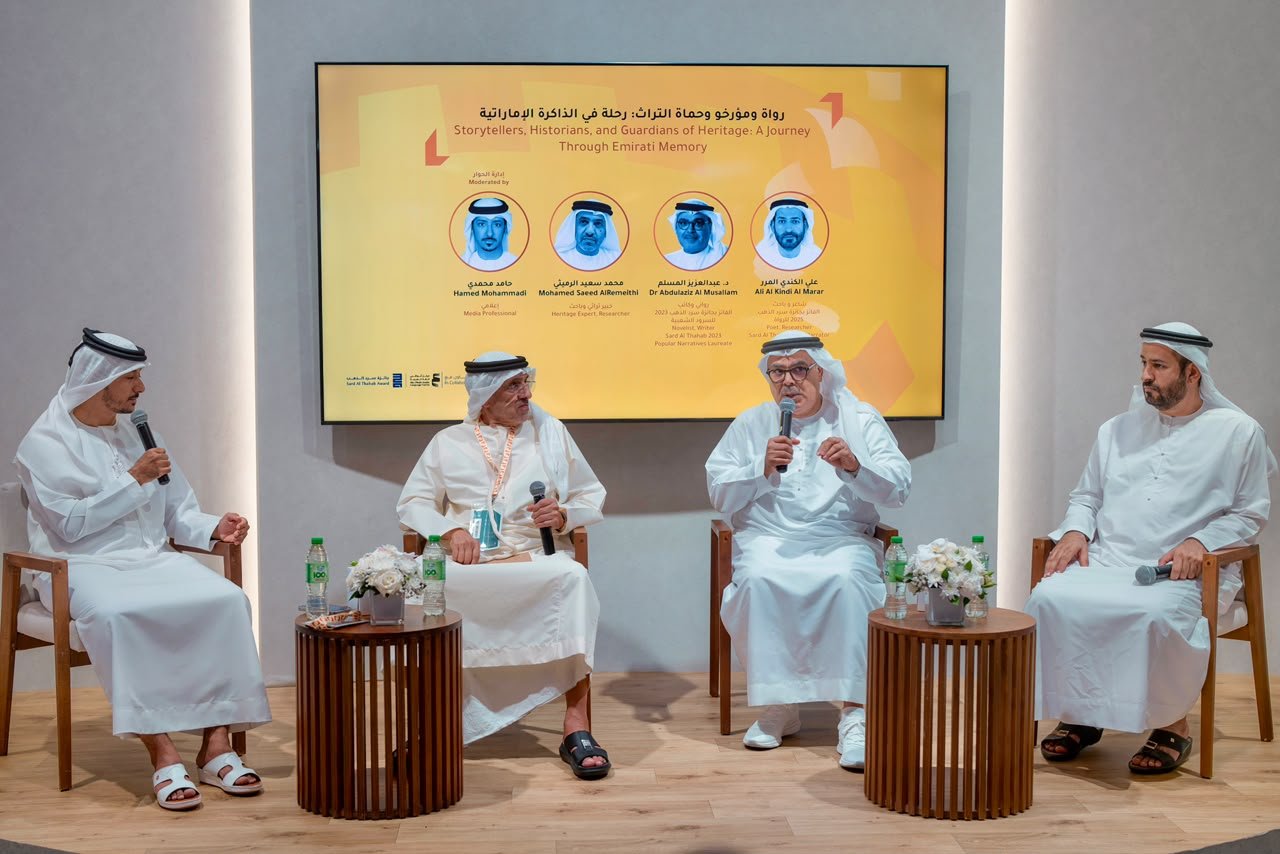
H.E. Dr. Abdulaziz Al Musallam, President of the Sharjah Institute for Heritage, participated in the panel discussion “Storytellers, Historians and Heritage Guardians: A Journey into the Emirati Memory,” presented by the Abu Dhabi Arabic Language Centre as part of the activities of the Abu Dhabi International Heritage Exhibition. The session highlighted oral heritage and the role of storytellers, researchers and institutions in preserving it and safeguarding the UAE’s collective memory.
The panel brought together poet and researcher Ali Al Kindi Al Marrar, winner of the 2025 Sird Al Thahab Award in the Storytellers category; Dr. Abdulaziz Al Musallam, novelist, researcher and winner of the 2023 Sird Al Thahab Award; and heritage expert and researcher Mohammed Saeed Al Romaithi. The session was moderated by media personality Hamed Mohammadi.
The speakers stressed that storytellers represent a fundamental pillar in preserving popular memory and transmitting details of life, experiences and knowledge passed down through generations. They underscored the importance of collecting and safeguarding oral heritage as a living source that documents aspects of the community’s history and cultural identity.
They also highlighted the value of drawing on storytellers’ memories and the wealth of stories, poetry, narratives and knowledge they preserve, while stressing the need to verify oral materials and cross-reference them with other sources to enhance their accuracy and credibility.
Comprehensive Approaches to Preserving Heritage
Al Musallam reviewed his experience with the Sird Al Thahab Award, highlighting the diversity and precision of its categories, particularly those related to storytellers and the narration of popular heritage. He explained that comprehensive approaches allow for the documentation and preservation of the various forms of heritage, without conflicting with specialization in subjects that require deeper research.
Institutional Efforts and Collective Memory
Addressing the role of institutional work in organising oral heritage, Al Musallam explained that the collection process follows two main paths. The first involves the efforts of independent collectors and researchers in tracing heritage in its various forms, while the second comprises projects undertaken by institutions according to specific themes and priorities.
He noted that some elements of heritage are particularly vulnerable to disappearance, while storytellers’ memories may gradually fade with the passage of time and changes in the pace of life.
Al Musallam stressed that collecting poems and oral narratives should not be limited to gathering and preserving materials, but requires genuine passion for the subject and an understanding of its environment and contexts.
He also reflected on his personal experience in storytelling and research into oral heritage, poetry and verse, noting that the environment, memories, and information gathered from individuals and storytellers constitute an important research resource. Each piece of information, he added, can open a new avenue for further research.
A Message to Researchers
Al Musallam addressed researchers who collect materials and information but do not take the initiative to publish them. He noted that concerns over the sensitivity of certain subjects or their potential impact on others can sometimes prevent valuable material from being made available.
At the same time, he pointed out that published research, through its exploration of both positive and negative aspects, has contributed to building an important body of knowledge and a valuable repository concerning the UAE’s heritage and geography. He stressed that publishing more of the work undertaken by researchers would have added significantly to this knowledge base.
He also emphasised the importance of verifying narratives and comparing different accounts, cautioning against treating everything that is narrated as absolute fact. Accounts may vary from one storyteller to another, or may acquire additional details over time. This requires researchers to exercise balance in their narratives and avoid embellishment or competing claims, in order to preserve the accuracy, credibility and value of heritage materials for future generations.