



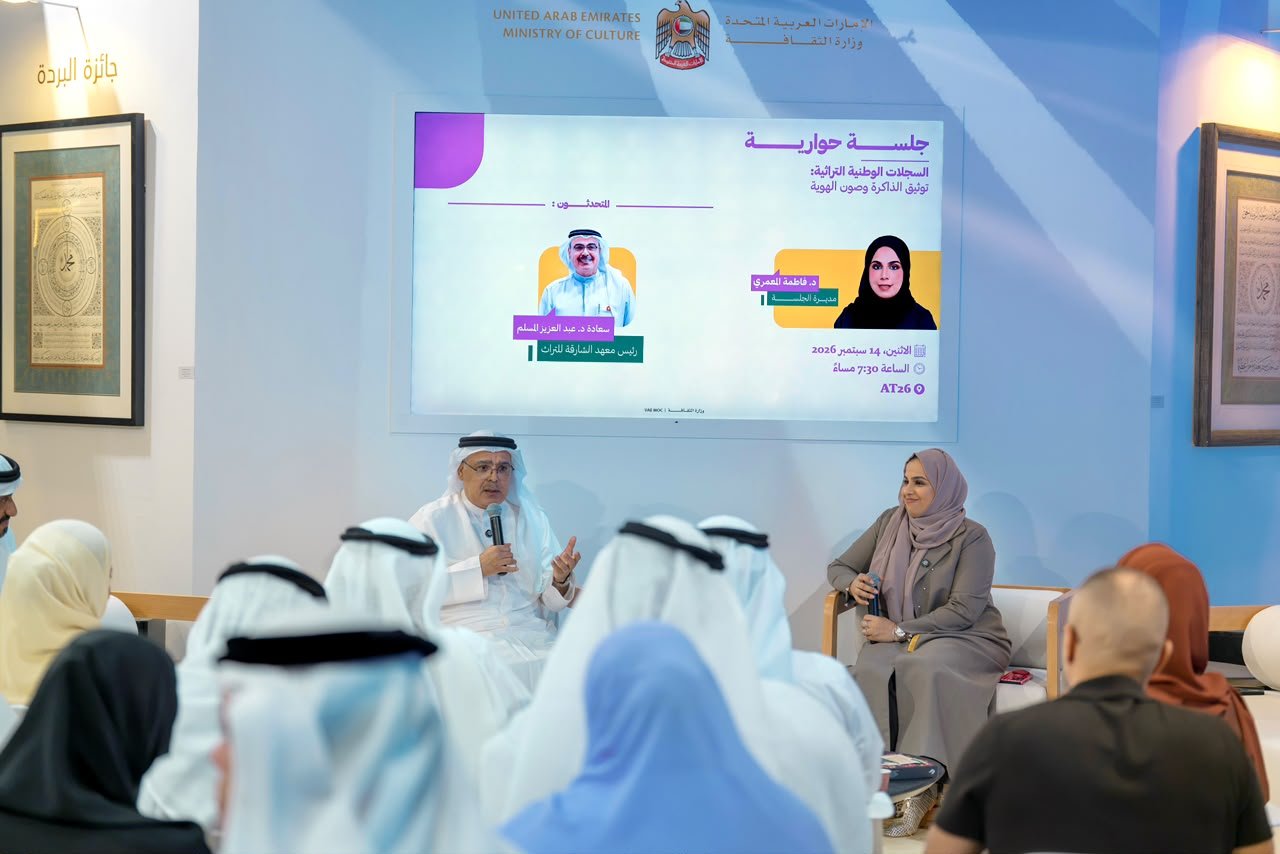
At the Abu Dhabi International Book Fair: Ministry of Culture hosts Dr. Al-Musallam to discuss heritage registers and safeguarding identity
The Ministry of Culture, as part of its cultural programme at the 2026 Abu Dhabi International Book Fair, hosted H.E. Dr. Abdulaziz Al-Musallam, Chairman of the Sharjah Institute for Heritage, in a dialogue session titled “National Heritage Registers: Documenting Memory and Safeguarding Identity.” The session explored the importance of heritage registers in preserving national memory, safeguarding elements of cultural heritage, and strengthening their presence and sustainability within society.
The session was moderated by Dr. Fatima Al-Maamari and attended by H.E. Abu Bakr Al-Kindi, Director of the Sharjah Institute for Heritage, along with a number of cultural and heritage specialists and enthusiasts.
Registers: A Memory Preserved for Generations
During the session, Dr. Abdulaziz Al-Musallam addressed a number of themes related to heritage registers and their role in documenting cultural heritage elements, preserving the knowledge and practices associated with them, and transmitting them to future generations.
He stressed that the value of registration extends beyond merely preserving a heritage element, but also encompasses its utilisation and reinvention in ways that strengthen its presence in cultural and community life.
He also highlighted the role of the narrator as a custodian of memory and an authentic source of inherited knowledge and stories. He underscored the importance of caring for narrators, recognising their status and treating them with the human appreciation they deserve for the experiences, stories and knowledge they carry, which form an integral part of the community’s cultural memory.
From Documentation to Cultural Action
Dr. Al-Musallam explained that a heritage register should not stop at documentation and recording, but should evolve into a living cultural project linked to a season or programme that reintroduces the registered element to the public through diverse outputs, including books, publications, recordings, performances and cultural materials.
He referred to the documentation of a number of traditional foods and heritage sites and their inclusion on heritage lists, stressing that registering such elements marks the beginning of a broader process aimed at maintaining public awareness of them and bringing them back into events, occasions and the cultural landscape. This, he noted, contributes to their revival and reinforces their place in collective memory.
Majlis: A Social Memory in the Heritage Register
Dr. Al-Musallam also discussed the majlis, or traditional gathering place, as one of the documented heritage elements. He explained that many traditional majlis are no longer preserved in the form and with the heritage functions for which they were once known, as a result of transformations brought about by modern lifestyles.
He stressed that this reality further highlights the importance of documentation as a means of preserving the image and social functions of the majlis, while recalling the values, practices and memories associated with it. This helps maintain its presence in collective memory even as its forms and functions evolve.
International Experiences Inspiring Heritage Preservation
Addressing international experiences, Dr. Al-Musallam highlighted a number of advanced initiatives and practices in heritage preservation and safeguarding, including experiences from the Italian island of Sardinia and the Kingdom of Morocco.
He noted that these experiences offer valuable models that can inform efforts to document cultural heritage, preserve its elements and reinterpret them in ways that respond to the present while maintaining their connection with younger generations.
“My Great Friend”: A New Publication on the Narrator and the Story
During the session, Dr. Abdulaziz Al-Musallam unveiled his new book, “My Great Friend,” which will be launched as part of the Sharjah International Narrator Forum.
The new publication represents a further addition to his intellectual and knowledge-based project focusing on the narrator, storytelling and cultural memory, as well as efforts to document intangible oral heritage and highlight its cultural value.
At the conclusion of the session, the Ministry of Culture honoured H.E. Dr. Abdulaziz Al-Musallam in recognition of his participation and contribution to enriching the dialogue, and for highlighting the importance of national heritage registers as essential tools for documenting memory, safeguarding identity and promoting the sustainability of heritage.