


The Bedouin Environment at Sharjah Heritage Days Tells the Story of the Desert and Humanity
Sharjah, 7 February 2026
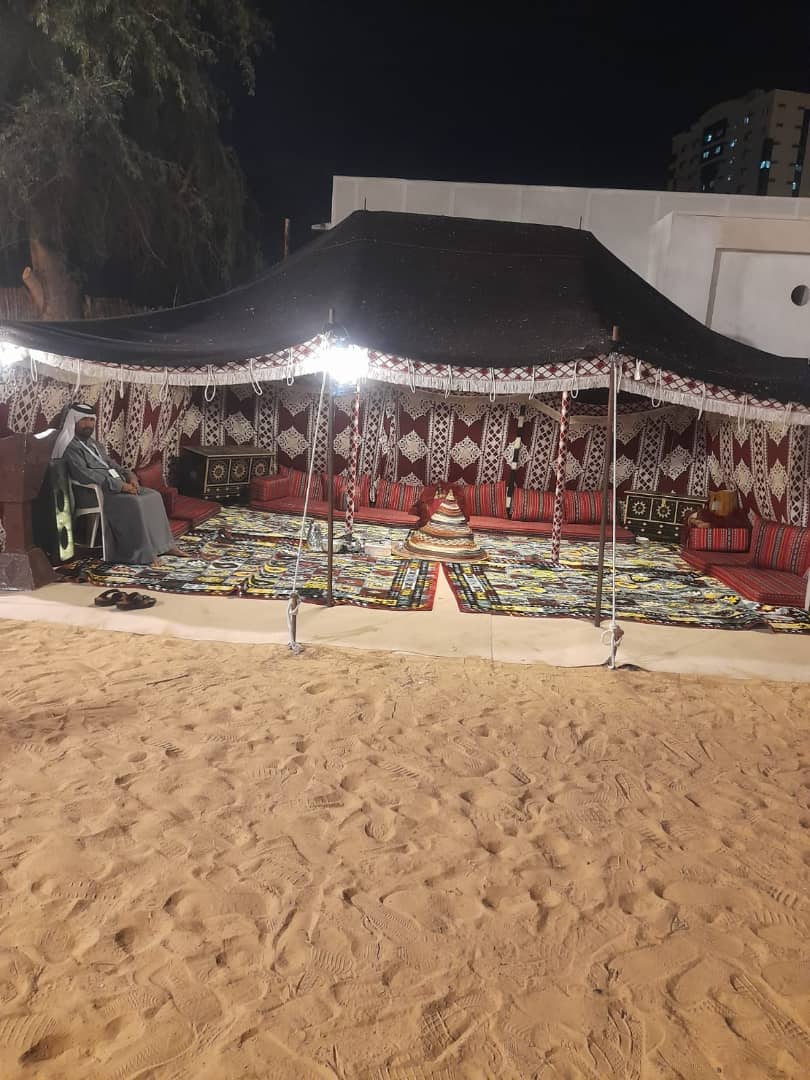
The Bedouin environment has drawn strong interest from visitors to the Emirati Environments Pavilion since the launch of the 23rd edition of Sharjah Heritage Days, due to its rich cultural and historical value that reflects the features of early life in the United Arab Emirates. It embodies the close relationship between humans and nature, and their adherence to authentic customs and traditions.
Scenes of Traditional Life
At the entrance to the Bedouin environment, visitors are welcomed by Rashid Mohammed Al Shilimi from Ras Al Khaimah, who provides a comprehensive explanation of traditional Bedouin life, its customs and traditions, and its economic and social conditions. He takes visitors on a journey that spans camel, sheep, and goat herding, celebrations and folk arts, as well as the bait al-sha‘ar (tent made of goat hair) and the men’s and guests’ majlis.
Introducing New Generations to Authentic Heritage
Al Shilimi emphasized the importance of introducing visitors—especially younger generations—to the details of Bedouin life, stressing the need to preserve heritage and pass it on to future generations as an essential part of national identity.
The Environment: Mobility and Nomadism
He explained that the Bedouin environment in the Gulf and the UAE was based on mobility and nomadic movement, reliance on herding and camel keeping, and building dwellings from woven hair. It was characterized by simplicity and the ability to adapt to the harsh desert environment.
Women’s Crafts and Traditional Activities
The Bedouin Environment Pavilion also highlights a notable female presence through demonstrations of traditional crafts such as Al Sadu weaving, spinning, tailoring garments, making leather tools, and churning milk—reflecting the vital role of women in Bedouin life.
Hospitality and Folk Heritage
Al Shilimi noted that camel riding and racing, along with Bedouin songs such as Al Shillah and Al Wannah, formed popular means of entertainment. Meanwhile, the Bedouin kitchen relied on dates and dairy products, including camel milk. He added that Arabic coffee is a symbol of hospitality, as drinking the first cup gives the host a sense of reassurance, while tea is served only upon explicit request.