



SIH Discusses Best Practices for Managing Cultural Heritage in Times of Crisis Through a Specialized Scientific Symposium
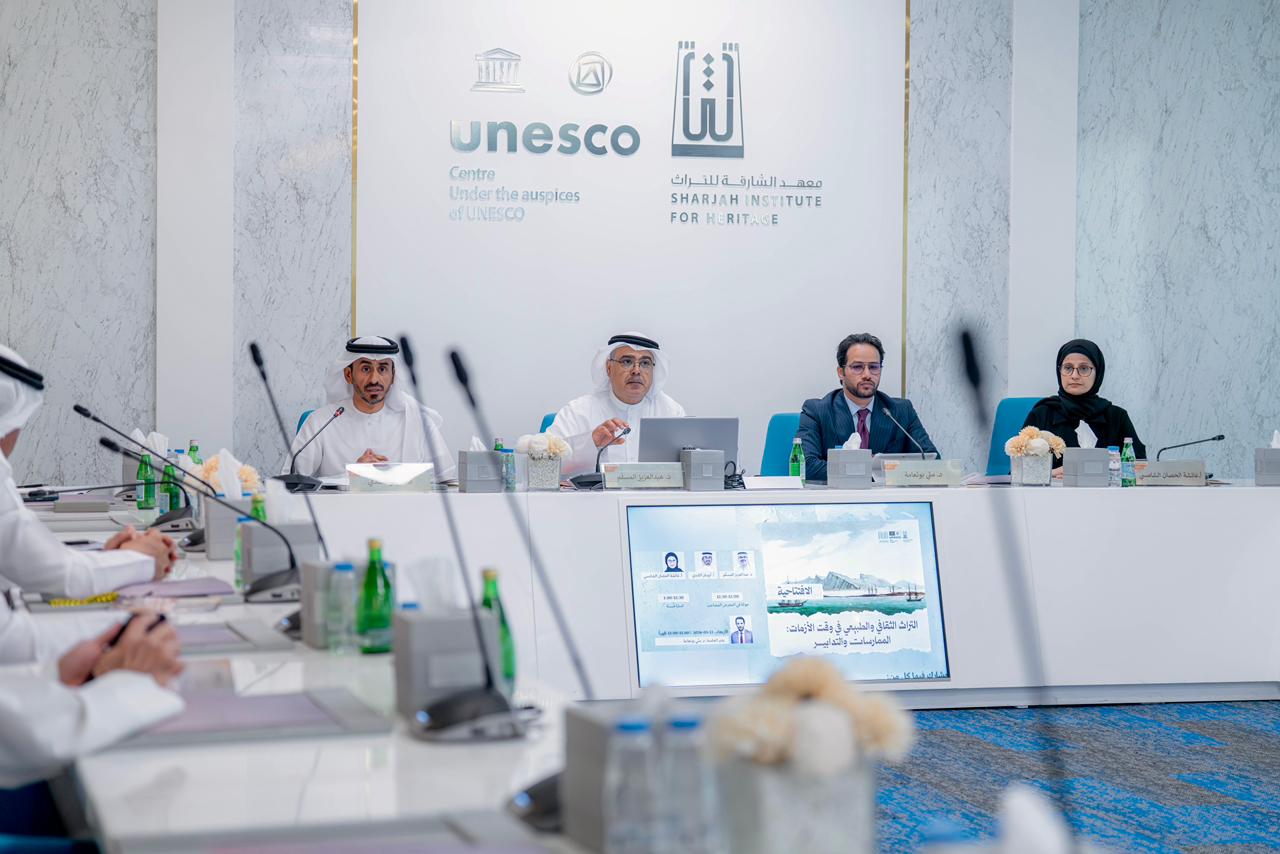
The activities of the scientific symposium titled “Best Practices in Cultural Heritage – Heritage Management in Times of Crisis” commenced today at the Sharjah Institute for Heritage, with distinguished Arab and Gulf participation, alongside a select group of academics, researchers, and specialists in cultural and heritage affairs.
Cultural Heritage in Times of Crisis
The opening session addressed the topic of cultural and natural heritage during times of crisis by reviewing the necessary practices and measures, with the participation of His Excellency Dr. Abdulaziz Al Musallam, Chairman of the Sharjah Institute for Heritage; His Excellency Abu Bakr Al Kindi, Director of the Sharjah Institute for Heritage; and Aisha Al Hosan Al Shamsi, Director of the Arab Heritage Center. The session was moderated by Dr. Mini Bouanama.
Al Musallam: Conflicts Threaten Humanity’s Memory
During his address at the opening session, His Excellency Dr. Abdulaziz Al Musallam stressed that wars and conflicts have historically posed a direct and serious threat to cultural and natural heritage because of the devastating impact they inflict on both people and places. He noted that the international community has moved swiftly to enact laws and agreements aimed at protecting human heritage during armed conflicts.
Dr. Al Musallam explained that the 1954 Hague Convention and subsequent international protocols established clear principles for safeguarding cultural property and preventing its targeting, military use, destruction, or looting. He pointed out that the devastation witnessed in historical cities and sites in Palmyra, Mosul, Yemen, Lebanon, Syria, Libya, and elsewhere highlights the urgent need to strengthen protection mechanisms and preserve humanity’s collective memory.
He added that the symposium seeks to shed light on the dangers threatening cultural and natural heritage, discuss the challenges facing institutions concerned with heritage protection, and highlight the role of international organizations, foremost among them UNESCO, in managing heritage during crises and disasters.
Al Kindi: Need for More Effective International Legislation
For his part, His Excellency Abu Bakr Al Kindi, Director of the Institute, emphasized that the symposium comes at a highly important time amid the growing conflicts and disputes affecting heritage and cultural sites worldwide. He stressed that protecting heritage requires strengthening international legislation and activating existing agreements to limit destruction, looting, and the illicit trafficking of cultural property.
Al Kindi also highlighted the importance of employing modern technologies to monitor violations and acts of vandalism targeting archaeological sites and to safeguard this human legacy through all possible means. He affirmed that the symposium aligns with the vision of the United Arab Emirates and the Emirate of Sharjah in supporting the preservation of human heritage and assisting countries affected by crises.
Aisha Al Shamsi: Prevention and Digital Documentation Are Essential
Meanwhile, Aisha Al Hosan Al Shamsi, Director of the Arab Heritage Center, explained that heritage management during crises is no longer limited to post-disaster intervention, but now depends on building preventive and proactive systems capable of ensuring the continuity of cultural work and adapting to emergency conditions.
Al Shamsi stressed the importance of establishing comprehensive digital databases and archives for heritage elements, including audio-visual documentation, maps, and oral knowledge, considering documentation today one of the most important tools for protection and cultural sustainability.
She also emphasized the need to involve local communities in safeguarding intangible heritage by empowering artisans and practitioners with documentation and digital transmission tools, alongside developing virtual platforms and digital exhibitions that ensure continued access to cultural and natural content even during times of crisis.
Specialized Scientific Sessions
The symposium includes several scientific sessions discussing best practices in managing cultural and natural heritage during crises, the risks threatening heritage sites, issues related to preservation, reconstruction, and rehabilitation, as well as the role of cultural institutions and local communities in protecting and sustaining human heritage.
The first session focused on “Best Practices in Managing Cultural and Natural Heritage in Times of Crisis: Concepts, Contexts, and Ethics,” with the participation of Dr. Saif Al Bedwawi, الأستاذ Talal Al Rumaidhi, Dr. Majid Boushalibi, and الأستاذ Fahd Al Maamari. The session was moderated by Dr. Hamad Bin Saray.
Ethical Concepts and Contexts of Heritage Management During Crises
The session presented scientific and field-based approaches addressing the relationship between wars, conflicts, and cultural and natural heritage, while reviewing various historical experiences and the direct impacts these conflicts have had on heritage sites and the cultural memory of societies.
The session also discussed the philosophy behind heritage management practices and their relationship with internationally adopted systems and policies, in addition to laws and legislation regulating heritage protection during crises.
Exhibition Showcasing Best Practices
The scientific symposium program also featured an accompanying exhibition organized in cooperation with ICCROM Sharjah, showcasing images of projects reflecting best protection practices through examples from the cultural heritage of several Arab cities affected by wars and armed conflicts. ICCROM Sharjah has provided urgent conservation support to protect these heritage landmarks from loss and destruction.
The symposium will continue over two days (Wednesday and Thursday), featuring a number of specialized scientific sessions examining issues related to the protection of cultural and natural heritage amid crises and conflicts, while highlighting key institutional experiences and practices in this field