



Virtual Roundtable Explores Strengthening the Role of Civil Society Organisations in Safeguarding Intangible Cultural Heritage in Arab Countries
The International Centre for Capacity Building in the Field of Intangible Cultural Heritage in the Arab Countries, a UNESCO Category 2 Centre under the auspices of UNESCO, in cooperation with the UNESCO Regional Office for the Gulf States and Yemen, held a virtual roundtable entitled “The Role of Civil Society Organisations in Safeguarding Intangible Cultural Heritage in Arab Countries: Perspectives and Experiences.”
The roundtable was organised as part of efforts to support the implementation of the 2003 UNESCO Convention for the Safeguarding of the Intangible Cultural Heritage and to strengthen the pivotal role of civil society organisations as strategic partners and effective links between local communities, heritage bearers and practitioners on the one hand, and official authorities on the other.
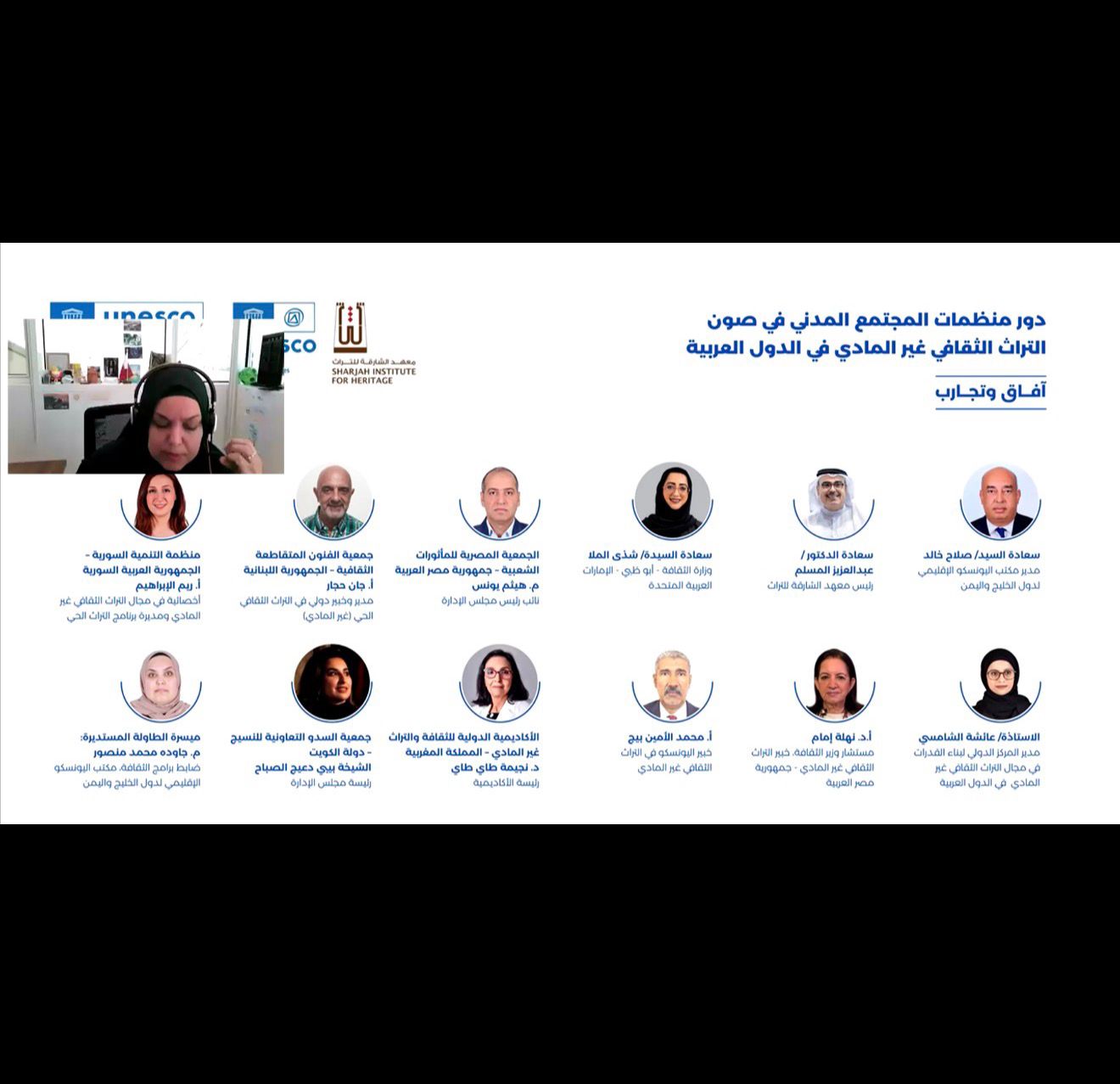
The meeting brought together a distinguished group of cultural leaders, experts and specialists. The opening session featured remarks by H.E. Abubakr Al Kindi, Director of the Sharjah Institute for Heritage; H.E. Salah Khaled, Director of the UNESCO Regional Office for the Gulf States and Yemen; H.E. Shatha Al Mulla, Assistant Undersecretary for the National Identity and Arts Sector at the Ministry of Culture; and Aisha Al Shamsi, Director of the International Centre for Capacity Building in the Field of Intangible Cultural Heritage in the Arab Countries.
Participants discussed the key challenges facing civil society organisations working to safeguard intangible cultural heritage, as well as ways to facilitate their accreditation under the 2003 Convention. Discussions also explored opportunities for exchanging expertise and successful experiences, developing sustainable funding mechanisms, and building high-quality partnerships that contribute to the long-term safeguarding of living heritage across the Arab countries.
The roundtable also addressed an initiative to safeguard traditional knowledge related to medicinal herbs and plants. The initiative aims to identify, document, safeguard and transmit such knowledge to younger generations, particularly in light of the risks of decline and discontinuity resulting from social, economic and environmental changes. Participants stressed the importance of implementing the initiative through partnerships with heritage bearers, civil society organisations, colleges of pharmacy, research centres and relevant international organisations.
Participants further discussed a proposal to establish an Arab Network of Civil Society Organisations working in the field of intangible cultural heritage, alongside an electronic platform containing data on these organisations. The initiative would facilitate communication and cooperation among them and support the development of joint Arab projects.
Proposed areas of work for the network include the preparation of an Arab Encyclopaedia of Traditional Knowledge, the development of networks for traditional crafts, and the implementation of projects focusing on heritage foods, environmental knowledge, folk arts and traditional music.
Participants proposed that the Sharjah Institute for Heritage, in its capacity as the International Centre for Capacity Building in the Field of Intangible Cultural Heritage in the Arab Countries, together with the National Commissions for UNESCO in Arab countries, support efforts to establish the network and develop its mechanisms and operational framework.